
Analyzing football matches requires more than passion or basic knowledge of the game. Moreover, while many fans believe they understand match dynamics, professionals know that incorrect assumptions often lead to flawed conclusions. In fact, even small analytical mistakes can significantly distort how a match is interpreted. Therefore, understanding football match analysis factors is essential for anyone who wants to evaluate games objectively and professionally.
This article highlights the most common mistakes people make when analyzing football matches and explains how to avoid them. As a result, recognizing these errors helps develop a more accurate and professional approach to football matches analysis.
Relying Too Much on Final Scores in Football Match Analysis
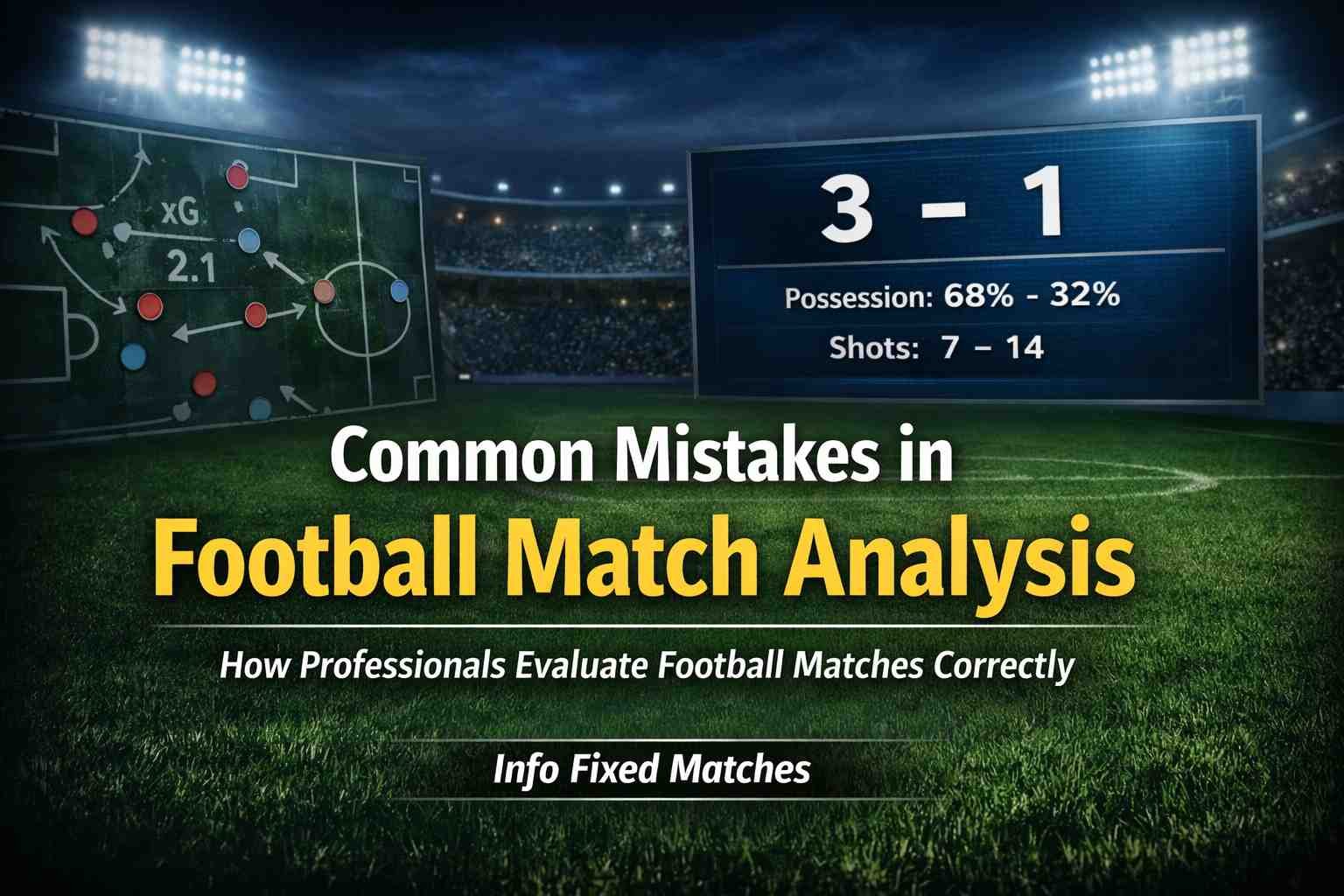
One of the most frequent mistakes in football match analysis is judging a game solely by its final score. However, while results matter, they rarely tell the full story.
A team can lose despite dominating possession, creating better chances, or controlling the tempo. Likewise, a team may win despite being second-best for most of the match.
Professional analysts always look beyond the scoreline and focus on performance indicators such as chance quality, tactical execution, and overall game control. Consequently, results without context often mislead.
These football match analysis factors help analysts understand why results happen, not just what the final score shows.
Ignoring Match Context When Analyzing Football Matches
Football matches never exist in isolation. For this reason, context plays a vital role in shaping performance, yet many people overlook it entirely.
Important contextual football match analysis factors include:
-
Fixture congestion
-
Travel distance
-
Weather conditions
-
Motivation levels
-
Squad rotation
For example, a team playing its third match in seven days may show reduced intensity. Similarly, a team already safe from relegation may approach matches differently than one fighting for survival.
Ignoring context leads to shallow and unreliable football match analysis.
Key Football Match Analysis Factors Professionals Use
For a deeper understanding of professional football analysis, readers can also explore our detailed guide on how to analyze football matches properly, which explains advanced methods used by experienced analysts.
Possession is one of the most misunderstood football statistics. On the surface, many assume that higher possession automatically means superiority, which is often incorrect.
Possession Quality in Professional Fixed Matches Analysis
Professional analysts distinguish between:
-
Purposeful possession that creates chances
-
Passive possession that lacks penetration
Some teams intentionally allow possession to exploit space on the counterattack. In such cases, lower possession may actually reflect a successful tactical approach.
Statistical Metrics Used in Football Match Analysis
Analysts frequently rely on advanced metrics such as expected goals (xG) when applying football match analysis factors, as explained on Wikipedia.
Drawing Conclusions from One Match Is a Costly Mistake
Short-term thinking is another major analytical error. Because football is a low-scoring sport, variance plays a significant role in match outcomes.
A single match can be affected by:
-
Red cards
-
Penalties
-
Individual errors
-
Refereeing decisions
Therefore, professionals avoid reacting emotionally to isolated games. Instead, they analyze patterns across multiple matches, which provides a far more reliable assessment of performance.
Misinterpreting Football Statistics During Match Analysis
Statistics are powerful tools, but only when interpreted correctly. Unfortunately, many people misuse data by focusing on raw numbers without understanding their context.
Common statistical mistakes include:
-
Valuing shot quantity over shot quality
-
Treating all leagues statistically the same
-
Ignoring opponent strength
For instance, ten low-quality shots from distance rarely equal three clear chances inside the box. As a result, professionals always evaluate statistics alongside tactical and situational factors.
Ignoring Tactical Matchups in Football Analysis
Tactical compatibility between teams often determines match outcomes. Nevertheless, many analyses ignore how playing styles interact.
For example:
-
High-pressing teams can disrupt slow build-up sides
-
Compact defensive teams can neutralize possession-heavy opponents
-
Wide attacks can exploit narrow defensive structures
Professional football match analysis always considers whether a team’s style naturally counters or complements its opponent.
Focusing Only on Star Players Instead of Team Structure
While star players influence matches, football remains a collective sport. Therefore, overemphasizing individual names often hides deeper structural issues.
Professional analysts examine:
-
Team shape
-
Midfield balance
-
Defensive organization
-
Off-the-ball movement
A team with lesser-known players but strong structure may outperform a squad with bigger names but poor cohesion.
Letting Bias Influence Football Match Analysis
Emotional bias is one of the hardest obstacles to overcome. Naturally, fans often analyze matches through personal preferences, favorite teams, or recent narratives.
Professional analysts reduce bias by:
-
Using objective data
-
Reviewing matches multiple times
-
Comparing performances across similar situations
As a result, removing bias leads to clearer and more consistent evaluations.
Final Thoughts on Avoiding Football Match Analysis Mistakes
Understanding football requires patience, discipline, and critical thinking. In conclusion, the most common mistakes in football match analysis stem from oversimplification, emotional reactions, and ignoring context.
These principles work best when combined with a structured approach to how to analyze football matches properly. Ultimately, avoiding these errors leads to deeper understanding and more professional-level match evaluations.